

Choosing a school in Suratgarh is rarely a decision made from a brochure. Most parents here already know a family whose child studies at the school they are considering. You ask at the shop, at the bank, at a wedding. One school is strict, another has good results, a third has a nice building. By the time you sit down for an actual enquiry, you have collected half a dozen opinions from people you trust.
That is a sensible way to begin, but opinions do not tell you how a school runs on an ordinary Tuesday in the middle of term. If you are weighing options for your child near Bhaggu Wala Kuan or anywhere else in and around Suratgarh, here is what actually sets DAV Public School Suratgarh apart, along with a few things it does not claim to be.
A teaching method that asks children to explain, not just recall
The single biggest difference shows up in how a lesson is taught, and it is also the hardest thing for a parent to judge from outside the gate.
The school is affiliated with the Rajasthan Board while classroom teaching follows a CBSE-style methodology, so concepts are built up through questioning, application and discussion rather than through dictation and repetition. For families who want CBSE-style learning in Suratgarh without moving a child out of the state board system, that combination is worth understanding before you decide.
In practice it means a science period is not finished when the definition has been copied into the notebook. The teacher will ask a child to explain why the answer works, ask another child to give an example from home, and only then move on. Mathematics is taught with the working shown and the reasoning spoken aloud, because a child who can only reproduce steps will stall the moment the question is reworded.
Why this matters by the time Class 10 arrives
Board papers have changed. A large part of the paper now tests whether a student can apply a concept to an unfamiliar situation. Children who have spent eight years learning to recall find that difficult, and the gap usually opens up in Class 9, when the syllabus stops rewarding memory alone. Children who have been asked to explain themselves since primary classes handle that transition far more comfortably. It is a long game, not a fix applied in the board year.
Teachers who have taught here long enough to know how children in Suratgarh learn
Any school can list qualifications. What is harder to build is a teaching team that has stayed long enough to develop judgement about local students.
With more than twenty years of classroom teaching behind the institution in Suratgarh, the faculty here have taught siblings, cousins, and in several cases the children of former students. That continuity produces a specific kind of skill. A teacher who has taught the same chapter for many years knows exactly which two lines confuse most students, and plans for it in advance instead of discovering it during revision.
It also changes how individual attention works, because children do not all arrive at understanding the same way. One student needs the concept drawn on the board before it makes sense. Another follows spoken explanation easily but loses the thread while copying from the board. A third understands perfectly well but goes blank in a written test out of nerves rather than gaps. Those are three different problems, and treating all three with extra homework helps none of them. Experienced teachers recognise the difference and adjust, which is something no fixed system or app can do for a child.
Results that hold up across years, not one strong batch
Every school in the area talks about board results. The question worth asking is not what last year’s result was, but what the result has looked like consistently over a stretch of years.
A single strong batch can happen for many reasons, including luck with a particular group of students. Consistency across years is much harder to fake, because it means the teaching process itself is working rather than one talented cohort carrying the numbers. DAV Public School Suratgarh has maintained steady and verifiable board results over the years, and parents are welcome to ask about them specifically during an enquiry visit rather than take a general claim at face value.
That is the right way to compare any school. Ask for results across the last several batches, not just the most recent one, and ask how many students appeared in each batch. Numbers that survive that question mean something.
Holistic development that has an actual slot on the timetable
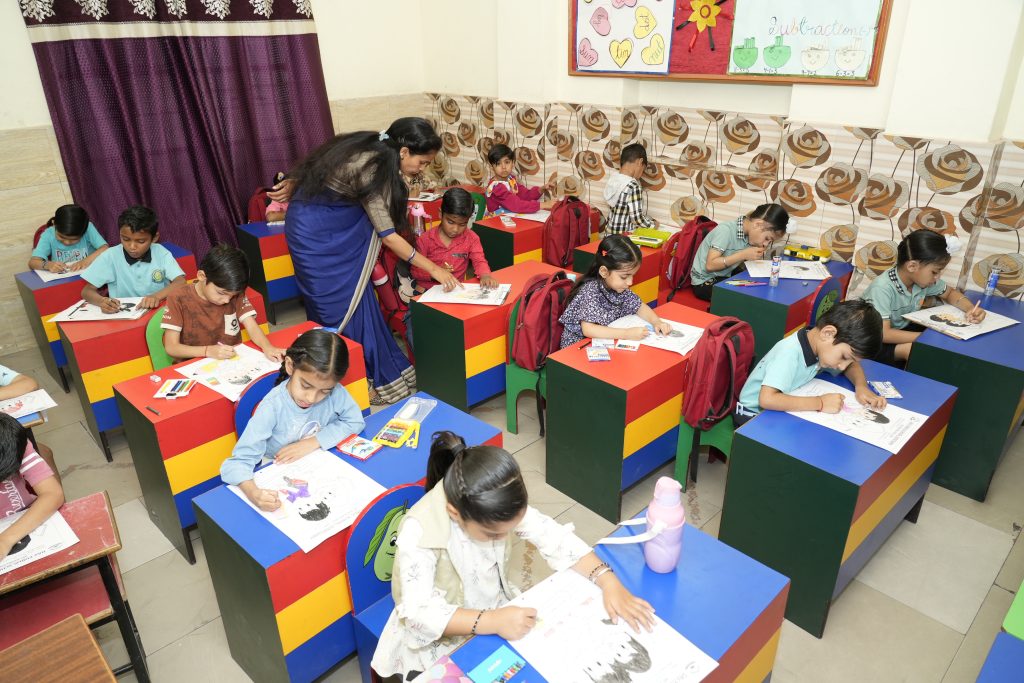
Most schools mention sports, arts and cultural activities. The meaningful difference is whether those activities are printed on the weekly timetable or squeezed in whenever the syllabus allows.
Here they are timetabled. Sports periods, art, and cultural activity sessions are scheduled alongside academic periods, which is a small structural decision with large consequences. When an activity has a fixed slot, it happens in October and it happens in January. When it does not, it quietly disappears the moment a portion falls behind schedule.
There is a practical reason for protecting that time beyond the usual talk of all round development. Children who spend the entire day seated and silent do not concentrate better in the afternoon, they concentrate worse. A scheduled games period is partly what makes the last two academic periods usable. Add the children who are not naturally strong in academics but come alive on a field or on a stage, and the case for keeping those periods intact is fairly obvious.
Safety treated as a system rather than a reassurance
For parents of younger children this is often the first question, and it deserves a specific answer rather than a comfortable one.
The campus is covered by CCTV, school transport is supervised rather than simply provided, and support staff are trained in what to do and who to inform when something goes wrong. The distinction that matters is between safety as a promise and safety as a routine. A promise depends on everyone being alert on a given day. A routine works even on a bad day, because responsibilities are assigned and checked.
Parents are encouraged to check this properly during a campus visit. Ask where the cameras are placed, who accompanies children on the bus route that would serve your area, and what happens if a child falls ill at eleven in the morning. Any school worth considering, this one included, should answer all three without hesitation.
Values practised in daily routine, not announced at assembly
Honesty, discipline and integrity appear on the website of almost every school in the country. Children learn none of it from a banner.
What they do learn from is repetition in ordinary situations. Whether a found item is handed in without anyone asking. Whether homework copied from a friend is quietly ignored or actually addressed. Whether a teacher who is wrong about something says so in front of the class. Whether the same rule applies to the confident child and the quiet one. Those small moments build character, and they either happen daily or they do not happen at all. This is where the DAV tradition of values based education becomes visible in a way parents can observe, usually through changes they notice in their own child at home rather than through anything the school says about itself.
What this school does not claim
Being useful to parents also means being clear about limits.
The school runs classes up to Class 10, so families will plan the next stage separately, and it is fair to factor that into your decision from the start. The school does not promise that every child will top the board. What it does commit to is that a child will be taught properly, watched over carefully, and known as an individual rather than a roll number.
That last point is often what parents in Suratgarh are really searching for when they look for the best school in Suratgarh for their child. Not the largest campus or the loudest advertising, but a place where somebody notices when a normally cheerful child turns quiet for a week.
Planning admission for your child
If this matches what you are looking for, the most useful next step is to visit. Walk through the campus during working hours, sit in the corridor for ten minutes, and watch how children speak to their teachers when nobody important is watching. That tells you more than any amount of reading.
For admission enquiries, fee details, transport routes or a campus visit, you can call us or visit our website. Come with your questions written down, including the difficult ones. A school that answers them clearly is usually a school worth trusting with your child.