
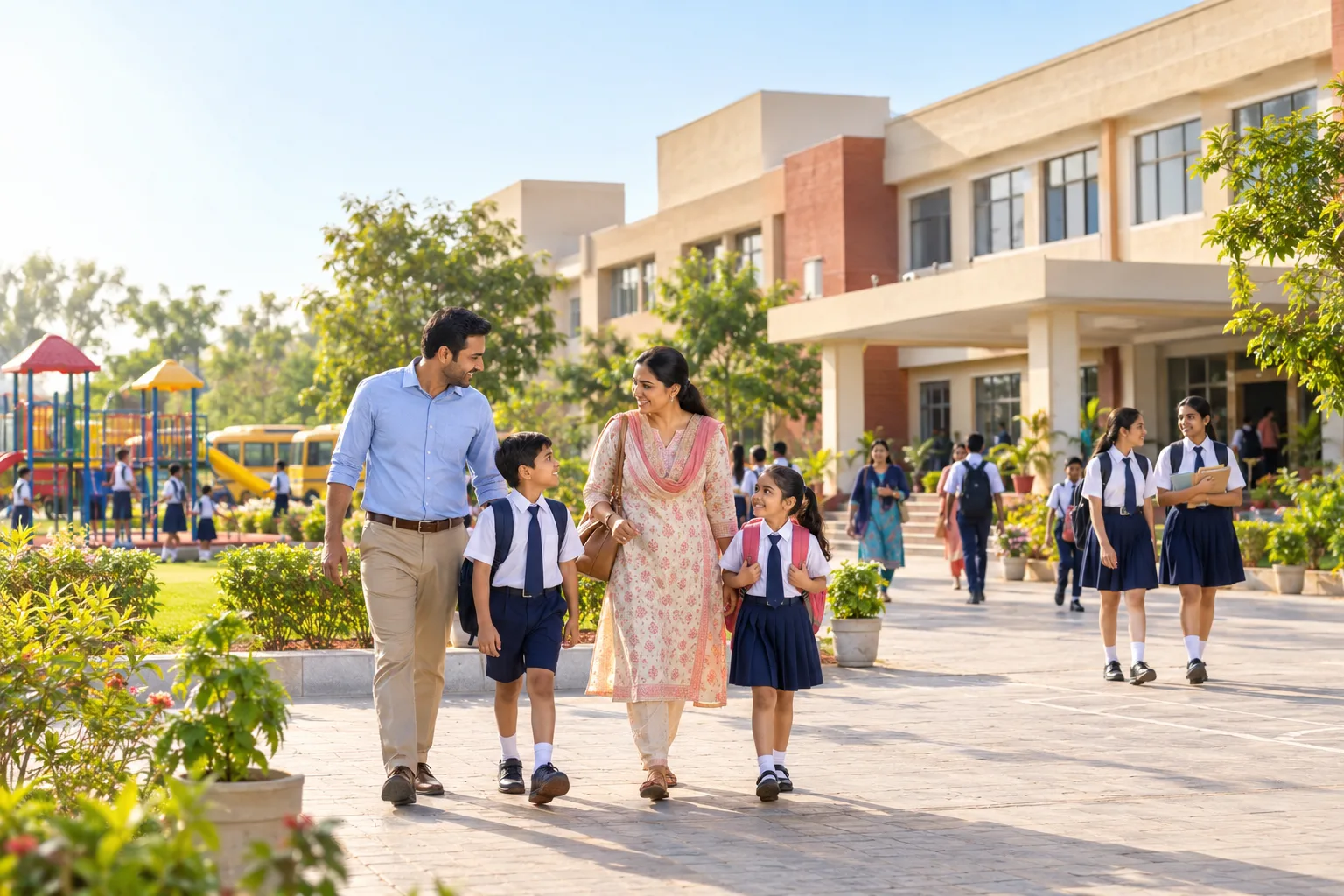
Schools in Suratgarh fall into two main groups: schools affiliated to the Rajasthan Board (RBSE) and schools affiliated to CBSE. Within each group you will find private English medium schools, Hindi medium schools and government schools. The right choice depends on your child’s current class, the board you want for Class 10 and 12 exams, and practical factors such as faculty, facilities, fees and distance from home.
This guide explains each board, what to look for at every school stage and how to compare schools side by side before you apply.
Which Boards Are Available for Schools in Suratgarh?
Most families here choose between two boards. Knowing how they differ makes every other decision easier.
RBSE (Board of Secondary Education, Rajasthan)
RBSE is the state board, headquartered in Ajmer. It conducts the Class 10 and Class 12 board examinations for a large share of students in Rajasthan. Many subjects now use NCERT-based textbooks, so the gap with CBSE content is smaller than many parents expect. RBSE is a practical choice for families who plan to stay in Rajasthan and whose children may later sit state-level recruitment exams.
CBSE (Central Board of Secondary Education)
CBSE is the national board. It follows NCERT textbooks and a syllabus that stays the same across India, which helps families in transferable jobs. Many national entrance exams, such as JEE and NEET, draw heavily from the NCERT syllabus.
A Third Route: RBSE Affiliation with CBSE-Pattern Teaching
Some schools combine the two. DAV Public School Suratgarh, for example, is affiliated to RBSE but teaches using CBSE-pattern methods, smart classrooms and continuous assessment. Students sit the RBSE board exams while learning through a teaching approach built around concept clarity rather than memorisation. For many local parents, this offers the familiarity of the state board with a more modern classroom style.
Tip: Always ask a school for its board affiliation in writing. Phrases like “CBSE pattern” or “CBSE style” describe teaching methods, not the board that will issue your child’s Class 10 certificate.
How to Choose a School by Level
What matters in a school changes as your child grows. Use this stage-by-stage view to focus on what counts right now.
Pre-Primary (Nursery and Kindergarten)
At this age, the classroom should feel like a safe place to explore. Look for:
- Play-based learning through stories, music, art and games
- Small groups and teachers who know each child by name
- Clean, child-safe rooms and supervised play areas
- A gentle settling-in routine for first-time school-goers
At DAV Suratgarh, pre-primary classes follow a play-based daily routine where storytelling, music and art are part of every day, not occasional extras.
Primary (Classes I to V)
These years build reading, writing and number skills. Ask how the school teaches:
- Activity-based lessons in place of rote drills
- Regular reading practice in both English and Hindi
- Simple, frequent feedback to parents on progress
Middle (Classes VI to VIII)
Subjects become deeper and more separate. A strong middle school offers:
- Working science and computer labs that students actually use
- Project-based learning and early exposure to STEM
- Sports, music and drama that keep students engaged beyond textbooks
Secondary (Classes IX and X)
This is board exam territory. Check for:
- A structured revision and testing plan across both years
- Remedial classes for students who fall behind
- Career guidance that starts before Class 10 results arrive
DAV Suratgarh’s secondary section combines exam-focused preparation with remedial support and early career guidance, so students are not left to plan their next step alone.
Senior Secondary (Classes XI and XII)
Here the stream choice (Science, Commerce or Humanities) matters most. Confirm which streams a school actually runs, the lab facilities for Science and whether subject teachers are specialists. Not every school in Suratgarh offers all three streams, so ask the admission office directly before you decide.
Key Factors to Evaluate Before You Apply

Once you know the board and stage, compare schools on these six factors.
1. Curriculum and Teaching Method
Ask to see a sample lesson plan or a weekly timetable. A good school can explain how it checks understanding, not just how it finishes the syllabus. Look for continuous and comprehensive evaluation that combines tests, projects and class participation.
2. Faculty Experience and Stability
Teachers who stay at a school for years understand local students and their families. Ask how long senior teachers have been at the school and how many students each class has. DAV Public School Suratgarh has taught students in Suratgarh for over 20 years, and much of its faculty has long classroom experience.
3. Infrastructure That Is Used Daily
Many schools list labs and libraries. Ask when students use them. During a visit, check:
- Smart classrooms in regular use
- Science and computer labs with working equipment
- A library students can borrow from
- Playgrounds for outdoor sports
4. Extracurricular Activities
Sports, arts and cultural events build confidence and teamwork. Ask whether these are timetabled or only held before annual functions. Photos and event posts on a school’s website are a good sign of regular activity.
5. Safety and Transport
For younger children especially, check CCTV coverage, supervised school transport on fixed routes, trained support staff and an on-campus medical room. Ask who travels with children on the bus.
6. Admission Process and Fees
A clear process saves stress. Ask for the admission timeline, required documents, any entrance interaction and the full fee structure, including transport, uniform and exam fees. Private schools in Rajasthan also reserve seats under the Right to Education (RTE) Act for eligible families, so ask the school about RTE admissions if they apply to you.
Comparing Schools in Suratgarh: A Quick Checklist
Use this table when you visit two or three schools. Fill in each column during or right after the visit.
| What to compare | Questions to ask | What a good answer looks like |
| Board | Which board issues the Class 10 certificate? | A clear answer: RBSE or CBSE |
| Classes offered | Up to which class can my child study here? | A stated range, confirmed on the admission form |
| Teaching method | How do you check understanding? | Continuous evaluation, projects, remedial classes |
| Faculty | How long have senior teachers been here? | Several years of stable, experienced staff |
| Facilities | When do students use the labs and library? | Scheduled weekly periods |
| Activities | Are sports and arts timetabled? | Yes, alongside academics |
| Safety | Is transport supervised? Is there CCTV? | Monitored routes, CCTV, medical room |
| Fees | What is the full yearly cost? | A written fee structure with all charges |
A school that answers these questions openly, in writing where possible, is usually one that will communicate well with you over the years.
Where DAV Public School Suratgarh Fits
If you want a state board school with a modern teaching style, DAV Public School Suratgarh is worth shortlisting. Here is how it measures up against the factors above:
- Board: RBSE affiliation with CBSE-pattern teaching
- Levels: Pre-Primary through Class 10, as listed on its admission process page
- Teaching: Smart classrooms, practical lab work and continuous evaluation
- Experience: Over 20 years of teaching in Suratgarh
- Facilities: Science and computer labs, library and playgrounds, plus activity rooms
- Safety: CCTV, supervised transport and a medical room
The school is located near Bhaggu Wala Kuan, Suratgarh. As with any school, visit the campus, meet the teachers and compare it with your other options before you decide.
Frequently Asked Questions
What boards do schools in Suratgarh follow?
Schools in Suratgarh mainly follow either RBSE, the Rajasthan state board, or CBSE, the national board. Some schools, such as DAV Public School Suratgarh, are affiliated to RBSE but use CBSE-pattern teaching methods. Always confirm the board that issues the Class 10 certificate, since “CBSE pattern” describes teaching style, not affiliation.
Is RBSE or CBSE better for my child?
Neither board is better for every child. CBSE suits families who may move between states and follows NCERT books used in national entrance exams. RBSE suits families settled in Rajasthan and now uses NCERT-based textbooks in many subjects. The quality of teaching at a school matters more than the board alone.
When should I start looking at schools in Suratgarh?
Start researching about six months before the new academic session. This gives you time to visit two or three schools, compare fees and collect documents. For nursery admission, check each school’s minimum age requirement, since it can vary. Ask each school for its admission dates directly.
What documents are needed for school admission in Suratgarh?
Most schools ask for the child’s birth certificate, passport-size photographs and address proof. Students moving from another school also need a transfer certificate and previous academic records. At DAV Public School Suratgarh, parents submit these after an initial inquiry and, for some classes, a short interaction or assessment.
Which classes does DAV Public School Suratgarh offer?
DAV Public School Suratgarh accepts admissions from Pre-Primary (Nursery and Kindergarten) through Class 10, according to its admission page. Learning is organised into Pre-Primary, Primary, Middle and Secondary stages. For questions about senior secondary classes or streams, parents should contact the school office directly.
How can I compare two schools fairly?
Visit both schools on a normal working day, not only at events. Use the same checklist at each: board, classes offered, teaching method, faculty experience, facilities, activities, safety and full fees. Ask for fee details in writing and talk to parents whose children already study there.